






Manufacturing has expanded for six straight months, but June’s data slowed on every gauge. At the same time, several margin tailwinds are potentially reversing. Freight costs are climbing; steel and copper remain near multi-year highs, and skilled labor continues to be expensive.
In the back half of 2026, manufacturers are likely to be rewarded less for momentum and more for cost discipline, pricing power, and operational execution. The margin gap between industrials at 12.4% and transportation at 9.6% is especially telling, as it shows which operators are managing volatility and which are absorbing it.
1. Manufacturing is Expanding, but its Momentum is Cooling
ISM Snapshot. Source: Institute for Supply Management (ISM)
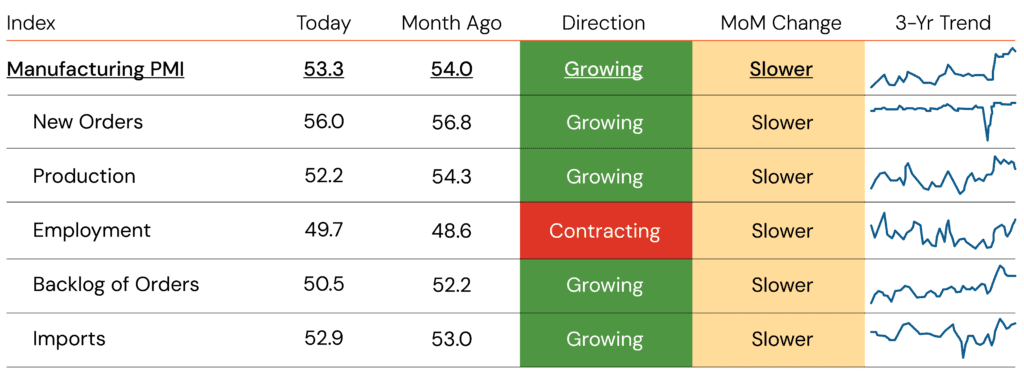
The PMI eased to 53.3 in June, marking a sixth consecutive month of growth. New Orders (56.0), Production (52.2), Backlogs (50.5), and Imports (52.9) all remained in expansion territory, though each slowed from the month before. Employment improved to 49.7, its strongest reading in months, but remained just below the line separating growth from contraction. When every index is expanding but also slowing in the same month, the message is clear: the cycle is moving from acceleration and into more tempered growth.
What this means for you: Use this cooling period to tighten execution. Rebuild capacity plans around realistic demand, keep automation and efficiency projects funded, and monitor employment closely. Its move toward 50 suggests that competitors may be preparing to add skilled workers again, which raises the cost of losing yours.
2. New Orders Still Lead Inventories
ISM New Orders less Inventories. Source: Bloomberg Finance, L.P.
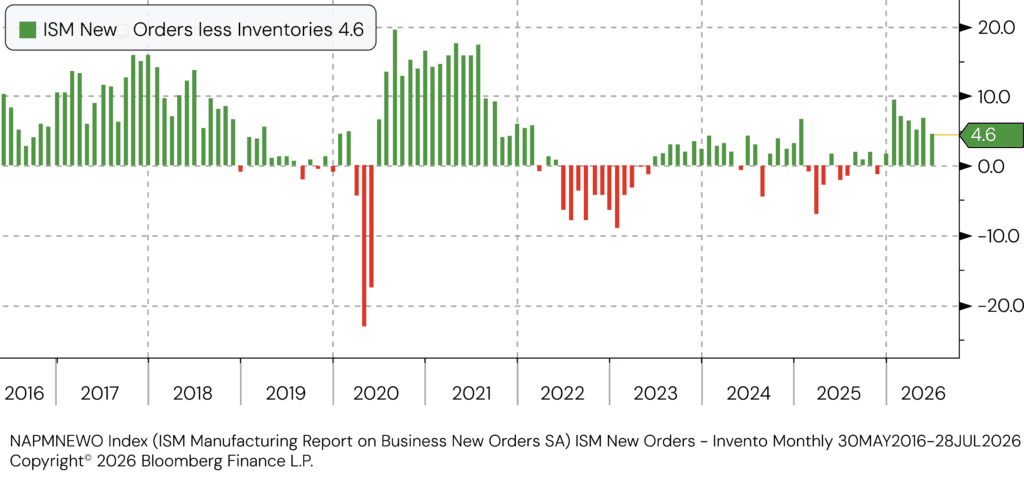
New Orders less Inventories came in at +4.6, down from 9.6 the month before. The reading has remained above zero for several months after hovering near or below the line through much of 2024 and 2025.
Yet, demand still runs ahead of inventory, and this spread remains one of the better early indicators on where production may head next. Positive orders coupled with lean inventory often set the stage for a restocking cycle. Still, the one-month decline is a real deceleration and deserves attention.
What this means for you: Restock selectively in your fastest moving lines but hold off on broad inventory builds until the trend firms again. Keep forecasts short-cycle, pressure-test supplier lead times, and identify which SKUs leave you exposed if demand slips from here.
3. Input Costs Stay High, Led by Steel, Copper, and Plastics
Input Prices. Source: Bloomberg Finance, L.P.
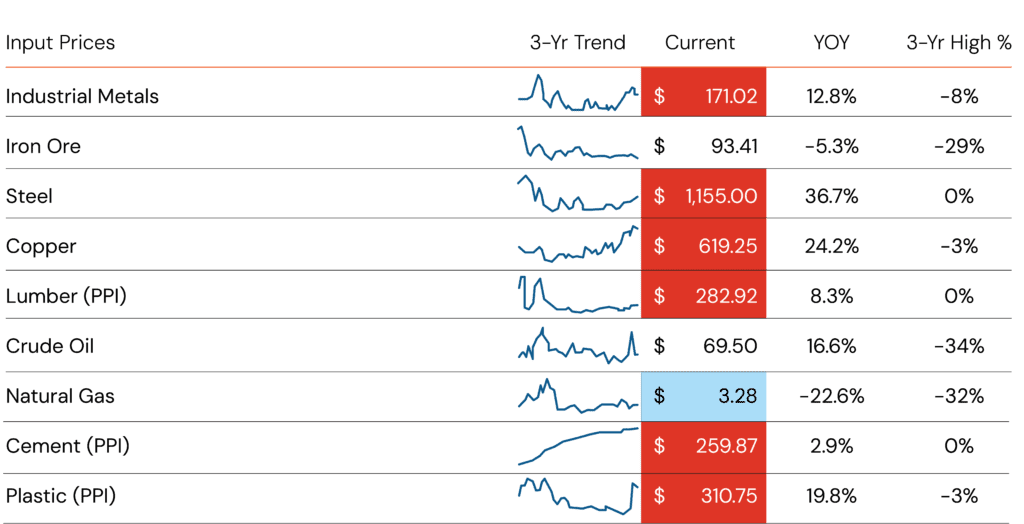
Key input costs remain elevated. Steel is up 36.7% year-over-year and sits at a three-year high. Copper has climbed 24.2%, plastics 19.8%, crude oil 16.6%, and industrial metals 12.8%.
However, relief is concentrated in energy and iron ore. Natural gas is down 22.6% and sits 32% below its three-year high, and iron ore has eased to 5.3%. But the costs continuing to rise are the structural ones driven by electrification, grid buildout, and AI data-center demand.
What this means for you: Treat steel, copper, and plastics as materials under sustained demand pressure and plan around prices holding. With steel at a three-year high, evaluate forward contracts or a strategic pre-buy at current levels. Capture the energy offset while natural gas remains low, and audit which increases you have passed through versus which you are still absorbing. Build the rest of your 2026 plan using today’s prices.
4. Manufacturing Wages Keep Their Premium
Manufacturing Wage Growth. Source: Bloomberg Finance, L.P.; Atlanta Fed Wage Growth Tracker
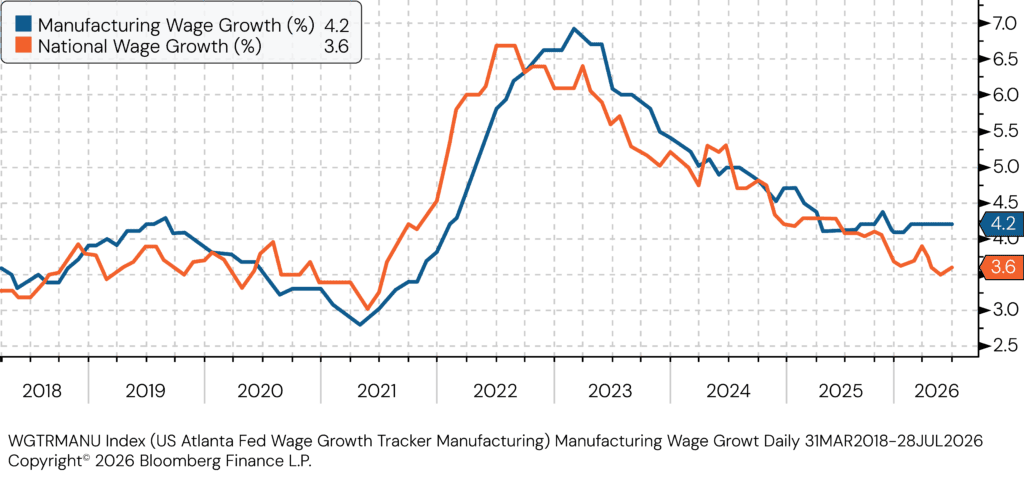
Manufacturing wage growth remains steady at 4.2% year-over-year, roughly six-tenths of a point above the national average. Both measures have cooled significantly from their 2022 and 2023 peaks, but the premium for skilled manufacturing labor remains intact.
Manufacturers may need fewer workers overall, but the roles they need most continue to become more expensive. The premium is concentrated in the roles a modern plant runs on: maintenance technicians, controls specialists, and seasoned production talent.
What this means for you: Retaining workers is usually less costly than replacing them. Focus on pay, training, and career paths for your highest-value technicians and operators first. Use automation to take pressure off the repetitive, lower-skill roles. With employment starting to firm, budget for the skilled labor premium to hold.
5. Freight Costs are Climbing Again
Container and Truck Rates. Source: Bloomberg Finance, L.P.
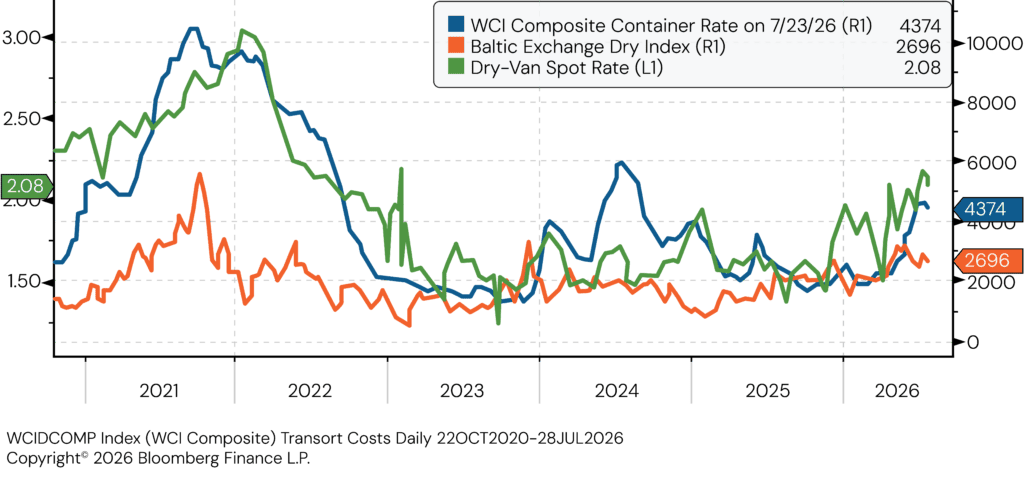
Ocean rates lead the move. The WCI composite container rate is approximately $4,400, up from about $2,800 earlier this year and at its highest in more than a year, driven by tariff front-loading and tight ocean capacity.
Dry-van truck spot rates have firmed to $2.08 per mile, rising from multi-year lows as domestic capacity rebalances. Meanwhile, the Baltic Dry Index has eased, pointing to softer demand for bulk commodities, such as iron ore, coal, and grain. The freight tailwind that gave shippers leverage for the past two years is fading, and the impact flows directly into margins.
What this means for you: If ocean freight is a meaningful cost, lock in contract rates now before the spot market climbs further. Truck rates remain low by historical standards but have leveled off, which means the window to renegotiate favorable trucking contracts may be closing. Because part of the container spike may reflect tariff front-loading, preserve flexibility across ocean, rail, and truck lanes. Refresh any freight assumptions built into your pricing before they become stale.
6. Margins are Diverging as Transportation Comes Under Pressure
EBITDA Margins. Source: Bloomberg Finance, L.P.; S&P 600
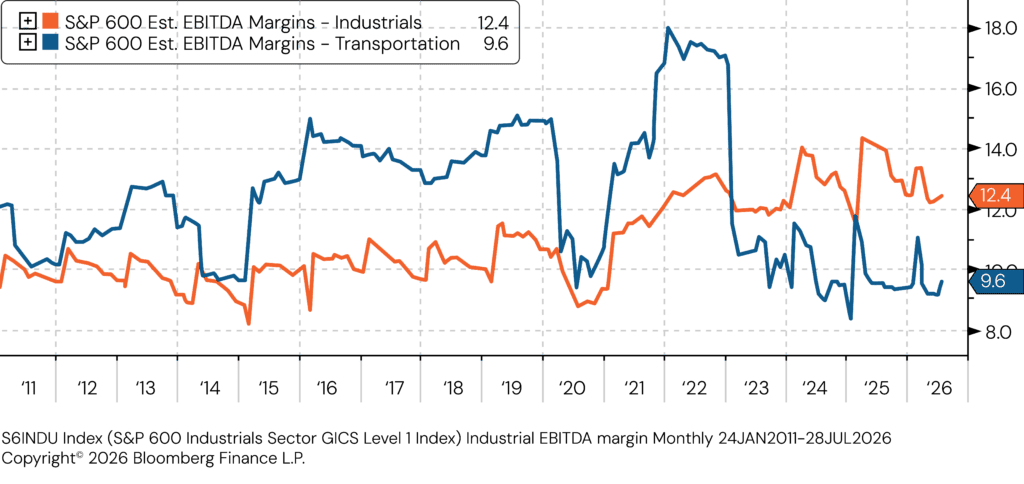
In the S&P 600, a small-cap index that maps closely to mid-market operators; industrial EBITDA margins are holding at 12.4%, while transportation has slipped to 9.6% from the double-digit levels of recent quarters. The split matters. Goods producers are largely holding steady, while carriers are absorbing the swings in freight and fuel. Industrial margin stability reflects a mix of cost control and pricing discipline. Transportation’s decline is also a warning. If you rely heavily on outsourced logistics, your carriers’ margin pressure may become your next rate increase.
What this means for you: Guard every basis point. Hold input costs tight, review pricing before you absorb the next increase, and run payback analysis on the automation that protects margin. Budget for logistics costs to rise from here and put that assumption into your contracts now. As the easy tailwinds fade, steady margins will be earned through execution.
This commentary is brought to you by Aprio advisors. If you have any questions, connect with our team today.
Disclosures
Investment advisory services are offered by Aprio Wealth Management, LLC, a Securities and Exchange Commission Registered Investment Advisor. Opinions expressed are as of the publication date and subject to change without notice. Aprio Wealth Management, LLC shall not be responsible for any trading decisions, damages, or other losses resulting from, or related to, the information, data, analyses or opinions contained herein or their use, which do not constitute investment advice, are provided as of the date written, are provided solely for informational purposes and therefore are not an offer to buy or sell a security. This commentary is for informational purposes only and has not been tailored to suit any individual. References to specific securities or investment options should not be considered an offer to purchase or sell that specific investment.
This commentary contains certain forward-looking statements. Forward-looking statements involve known and unknown risks, uncertainties and other factors which may cause the actual results to differ materially and/or substantially from any future results, performance or achievements expressed or implied by those projected in the forward-looking statements for any reason. No graph, chart, or formula in this presentation can be used in and of itself to determine which securities to buy or sell, when to buy or sell securities, whether to invest using this investment strategy, or whether to engage Aprio Wealth Management, LLC’s investment advisory services.
Investments in securities are subject to investment risk, including possible loss of principal. Prices of securities may fluctuate from time to time and may even become valueless. Any securities mentioned in this commentary are not FDIC-insured, may lose value, and are not guaranteed by a bank or other financial institution. Before making any investment decision, investors should read and consider all the relevant investment product information. Investors should seriously consider if the investment is suitable for them by referencing their own financial position, investment objectives, and risk profile before making any investment decision. There can be no assurance that any financial strategy will be successful.
Certain investor qualifications may apply. Definitions for Qualified Purchaser, Qualified Client and Accredited Investor can be found from multiple sources online or in the SEC’s glossary found here https://www.sec.gov/education/glossary/jargon-z#Q