





Summary: As the federal government expands its use of acquisition methods beyond the Federal Acquisition Regulation (FAR), it is more important than ever for contractors to understand the types of awards available and the rules that govern them. We answer the frequently asked questions about FAR-based acquisitions, Other Transactions (OTs), and grants, covering the purpose, structure, and key considerations of each. Understanding these distinctions can help contractors of all sizes identify the right opportunities, negotiate favorable terms, and meet their obligations to the government.
Introduction
Federal contracting is undergoing meaningful change. The Revolutionary Federal Acquisition Regulation (FAR) Overhaul, led by the General Services Administration (GSA), is advancing into rulemaking, and recent directives are encouraging agencies to use acquisition methods outside of the FAR when possible. These developments are expanding opportunities and lowering barriers for contractors, but they also make it critical to understand how the government approaches procurement today.
As part of an article series of frequently asked questions in federal contracting, Aprio’s Government Contracting team has collected some of the most asked questions about the types of awards available—both governed by and outside of the FAR.
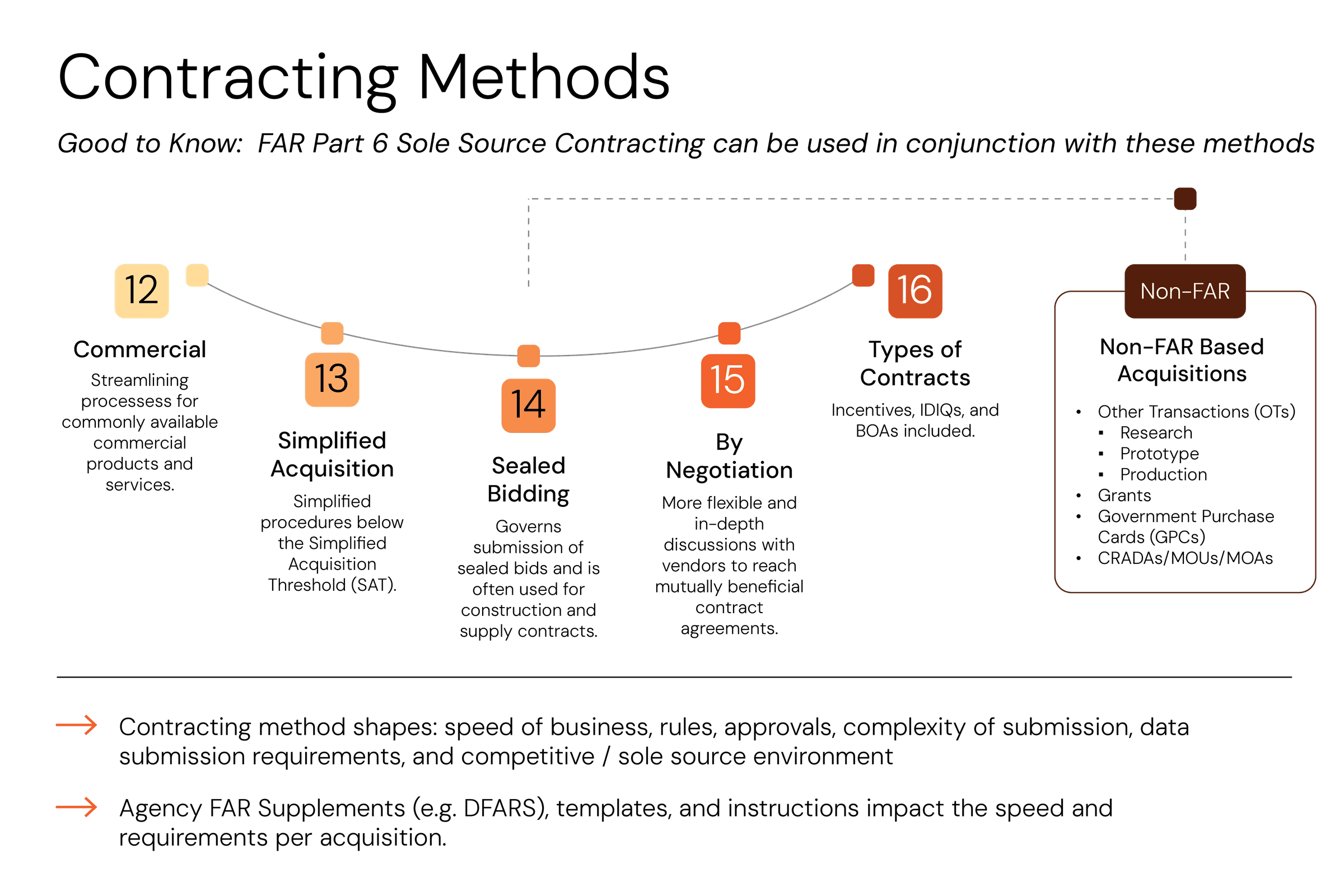
Figure 1: Contracting Methods
What is a FAR-based acquisition?
At its core, the Federal Acquisition Regulation (FAR) is the U.S. Government’s rulebook for buying goods and services. It is a complex set of regulations that provides guidance to government buyers for the entire acquisition lifecycle, as codified in the Code of Federal Regulations (CFR).
A FAR-based acquisition is when the government utilizes the FAR to plan, solicit, and execute a contract. Contracting Officers (COs) and Contract Specialists (CSs) use the FAR’s 53 parts to govern the methods used when contacting companies for industry and market research, negotiating data rights, determining contract type, termination, and more, all the way through closing out contracts and retaining records.
FAR-based acquisitions include Commercial Purchases (Part 12), Simplified Acquisitions (Part 13), Sealed Bidding (Part 14), and Contracting by Negotiation (Part 15). Additionally, contract types like Indefinite Delivery Indefinite Quantity (IDIQ) and Basic Ordering Agreements (BOA) are FAR-based (Part 16).
The FAR is the universal baseline for working with the government. Most agencies have at least one supplement to the FAR that can further restrict or clarify the requirements and regulations. Separately, agencies often have templates and guidance for implementing the requirements in the FAR. With the Revolutionary FAR Overhaul, there are now additionally a Companion Guide and Practitioner Albums for each FAR section. If your acquisition is FAR-based, then both the government and the contractor need familiarity with each of these documents.
In short, it is essential to understand if you are operating in a FAR-based or non-FAR-based acquisition. If an acquisition is FAR-based, then government contractors can find the provisions, clauses, and details associated with their agreement within the FAR, and understand the government’s position and interpretation of the agreement.
What does it mean to have an award outside of the FAR?
Generally, FAR governs awards for the federal government. Most competitions, sole source awards, and other acquisitions are governed by the policies and practices included in the FAR. However, the government has other methods of acquisition available to them.
Non-FAR based acquisitions include Grants, Other Transactions, purchases on Government Purchase Cards (GPCs), and non-monetary agreements including Cooperative Research and Development Agreements (CRADAs) and Memorandums of Understanding/Agreement (MOUs/MOAs).
What is an Other Transaction (OT)? How is it different from traditional government contracting methods?
Other Transactions (OTs) are a way for the government to buy in an agile, forward-leaning way from non-traditional defense contractors. It is important to note that these are agreements, not contracts, so the government counterpart authorized to enter into the agreement is called an Agreement Officer, and the award is not technically a contract.
By definition, a non-traditional defense contractor means “an entity that is not currently performing and has not performed, for at least the one-year period preceding the solicitation of sources by the Department of Defense for the procurement or transaction, any contract or subcontract for the Department of Defense that is subject to full coverage under the cost accounting standards prescribed pursuant to section 1502 of title 41 and the regulations implementing such section.” Practically, this means companies that are not performing contracts that are subject to the Cost Accounting Standards and do not meet certain thresholds for work within the DOD/DOW.
The purpose of an OT is to reduce administrative burden and provide maximum flexibility in research and development (R&D), encouraging non-traditional defense contractors to participate and foster innovation.
There are three types of OT: Research, Prototype, and Production.
Types of Other Transactions (OTs)
| NAME | DESCRIPITON |
|---|---|
| Research OT | For basic, applied, and advanced research that is early or new |
| Prototype OT | For developing and demonstrating new technologies and techniques |
| Production OT | For follow-on work after a successful prototype is complete*
*Production OTs are not awarded separately. |
Table 1: Three Types of Other Transactions (OTs)
The terms within OTs are not tied to the FAR, though they can be similar or substantially the same. It is important to know that these terms are completely negotiable and highly flexible because the FAR and FAR supplements (e.g., DFARS) do not apply. That being said, vigilance is still necessary to ensure that the terms and conditions within the agreement are appropriate, and all requirements and obligations can be met.
With the lower barriers to entry and negotiable terms, this is a great way for R&D consortia, small businesses, startups, and even academic/research institutions to work with the government more easily. Traditional defense contractors may also participate if they partner with a nontraditional contractor or provide a significant cost share, but it is best to check the individual OT to determine eligibility.
What is the difference between a traditional government contract, an OT, and a grant?
Traditional government contracts, OTs, and grants are all formal agreements with the U.S. federal government with money involved. However, the purpose of each and arrangement between parties are different.
Traditional Government Contracts
A traditional government contract is governed by the FAR and highly regulated. Contracts are for acquiring goods and services, including research and development and commercial products and services. These legally binding agreements are usually an exchange and are more limited in the types of interactions the government can have with industry—the government states a requirement, the contractor offers a way to meet those requirements, and money is exchanged for those goods and services. While there is some innovation in the FAR, including the use of Broad Agency Announcements (BAAs), most of the most innovative aspects of the relationship must happen in the market research and planning stages. FAR-based contract awards usually take longer than non-FAR-based awards because of all the policies, rules, and regulations.
Other Transactions
Other transactions are much broader in nature and are not governed by the FAR. Instead, they are based in U.S.C. and vary by agency. Their primary purpose is to offer non-traditional contractors an opportunity to work with the government in innovative ways, while allowing the government to better take advantage of industry. They are fast and flexible, with just about all aspects of the agreements being negotiable.
Grants
Grants are different still, where the government offers financial assistance when the primary purpose is to support or stimulate a public purpose (e.g. research, education, community programs), rather than acquire goods and services for its own use. Grants provide more flexibility to the recipient, with oversight focused on the proper use of funds rather than strict compliance with deliverables. This financial oversight can be burdensome on recipients of grants with program or single audit, reporting, cost share, and indirect rate requirements, so it is important to be aware of the government’s requirements even at application.
Like OTs, grants are not governed by the FAR, but rather by Uniform Grant Guidance. Also of note, grants may have cost sharing/matching requirements and should be reviewed thoroughly so that you know what your obligations as a government contractor include.
Final Thoughts
Whether your organization is new to federal contracting or looking to diversify beyond traditional FAR-based awards, understanding the rules and expectations of each award type is essential to protecting your interests and meeting your obligations. The flexibility of OTs and the financial structure of grants can open doors, but they also come with requirements that deserve careful attention. Aprio helps organizations evaluate opportunities, negotiate terms, and build the compliance infrastructure needed to perform successfully. Contact our team to discuss how these award types apply to your business and what steps you can take now to prepare.