

Solutions Who We Serve Insights & Events About Contact

2025 End of Year Tax Update

The One Big Beautiful Bill (OBBB), enacted on July 4, 2025, is shaking up the tax world for everyone.

Why does this matter?

Tax laws are rarely static. They are constantly evolving, bringing new regulations, opportunities, and responsibilities, some temporary and some permanent. While much remains up in the air, what is clear as 2025 comes to a close is that the tax landscape is more complex than ever before.

In Aprio’s 2025 year-end tax update, we break down the most notable twists and shifts in federal, state, and international taxes impacting businesses and individuals.

Shot from below, towering reflective skyscrapers soar up into a clear blue sky. Text in the bottom right reads

Business Tax

Business tax strategy is undergoing significant changes since the passing of the OBBB, empowering business owners with 100% bonus depreciation, expanded opportunities in R&D expensing, and increased Section 179 limits. In addition, the QSBS exclusion has been raised, opening doors for broader eligibility. Read More

Individual Tax

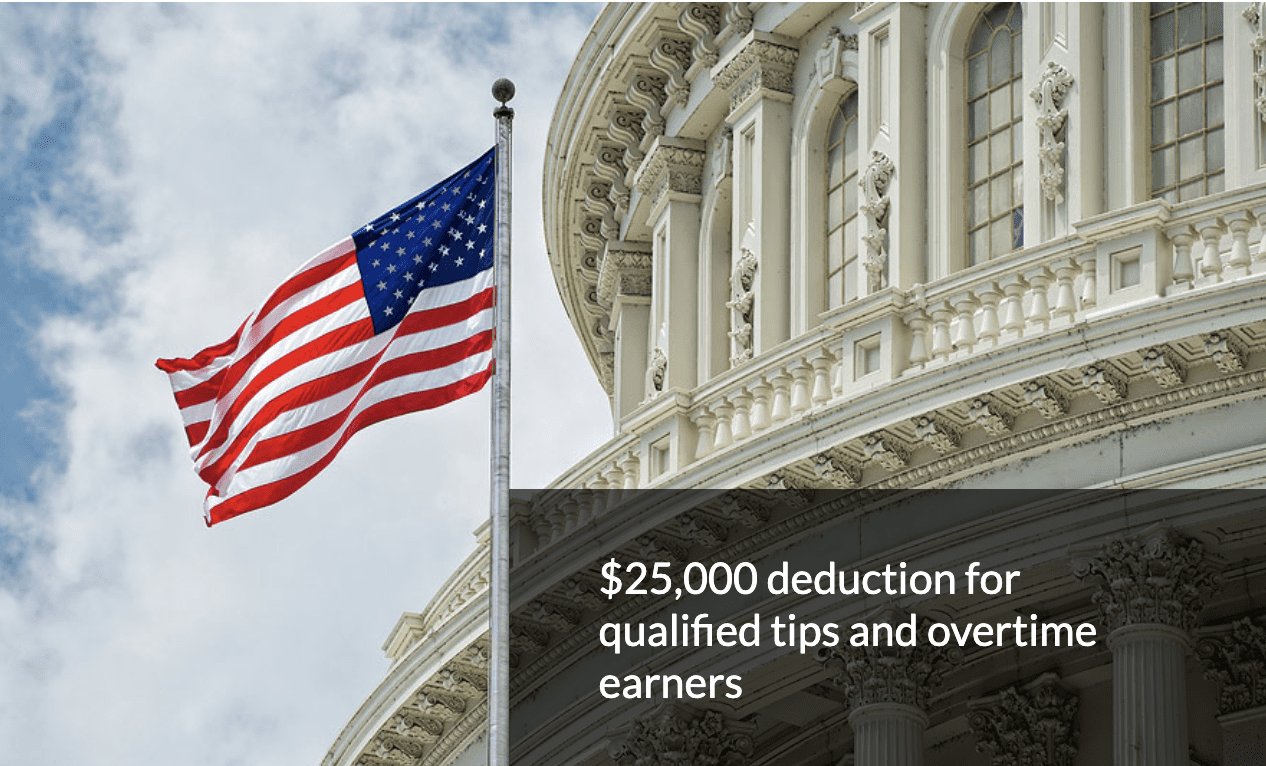
Several favorable provisions impacting individuals from the TCJA have been made permanent or were expanded with the passage of the OBBB. New tax-saving opportunities were also introduced, notably the new deduction for qualified tips and overtime compensation. Read More

Exterior shot of an ornate government building with an American flag raised in front of it. Text in the bottom right reads '$25,000 deduction for qualified tips and overtime earners
Tiny cardboard model of a house sits on a stack of papers alongside gold coins. Text in bottom left reads

Estate & Gift Tax

The OBBB permanently extended the estate and gift tax exemption, raising the federal lifetime exemption to $15 million for tax years starting after December 31, 2025. Strategic planning will be essential to maximize this tax advantage. Addressing non-tax concerns, such as asset protection, healthcare directives, guardianship, and business succession will be key. Read More

International Tax

International tax laws are evolving amid rapid globalization and digital transformation. The OBBB, new treaties, and the landmark ruling in Facebook, Inc. v. Commissioner have ushered in stricter rules for profit-shifting, transfer pricing, and foreign tax credits. Other notable changes businesses must be aware of include the Belarus treaty suspension, clarified PTEP regulations, and reduced GILTI (now NCTI) deduction rates. Read More

Digital rendering of the globe in blue with glowing blue dots connecting the continents. In the bottom left corner, white text reads
Aerial shot of a cargo ship alongside a light wooden dock in a blue sea. Text in bottom left reads

Tariffs

President Trump’s 2025 global tariffs, imposed under the IEEPA, have sparked constitutional challenges and divided courts, with the Supreme Court set to decide their fate. If overturned, billions in refunds may be issued to U.S. businesses, while upholding them would require ongoing adaptation. The ruling will profoundly impact trade policy, business costs, and the broader economy, making close monitoring essential for all stakeholders. Read More

State and Local Tax

The OBBB sparked changes in state and local taxation (SALT) rules, especially after raising the SALT deduction cap to $40,000 through 2029. Despite uncertainty on expiration dates, states have begun responding by expanding pass-through entity tax (PTET) programs. Varied approaches to federal conformity and evolving rules for bonus depreciation, net operating losses, and income apportionment reflect a complex shift in the SALT landscape. Read More

On a screen, a digital growth chart spikes up and down over a digital rendering of the American flag. Text in the bottom right reads
Shot through a glass wall, employees sit or stand around a conference room table. White text in the bottom left reads

Employment Tax

The OBBB and evolving IRS guidance has made year-end employment tax compliance increasingly complex. Notable changes impacting business and individuals include permanent credits for family and medical leave, new rules for overtime and tips, and a heighted focus on state tax obligations. Read More