

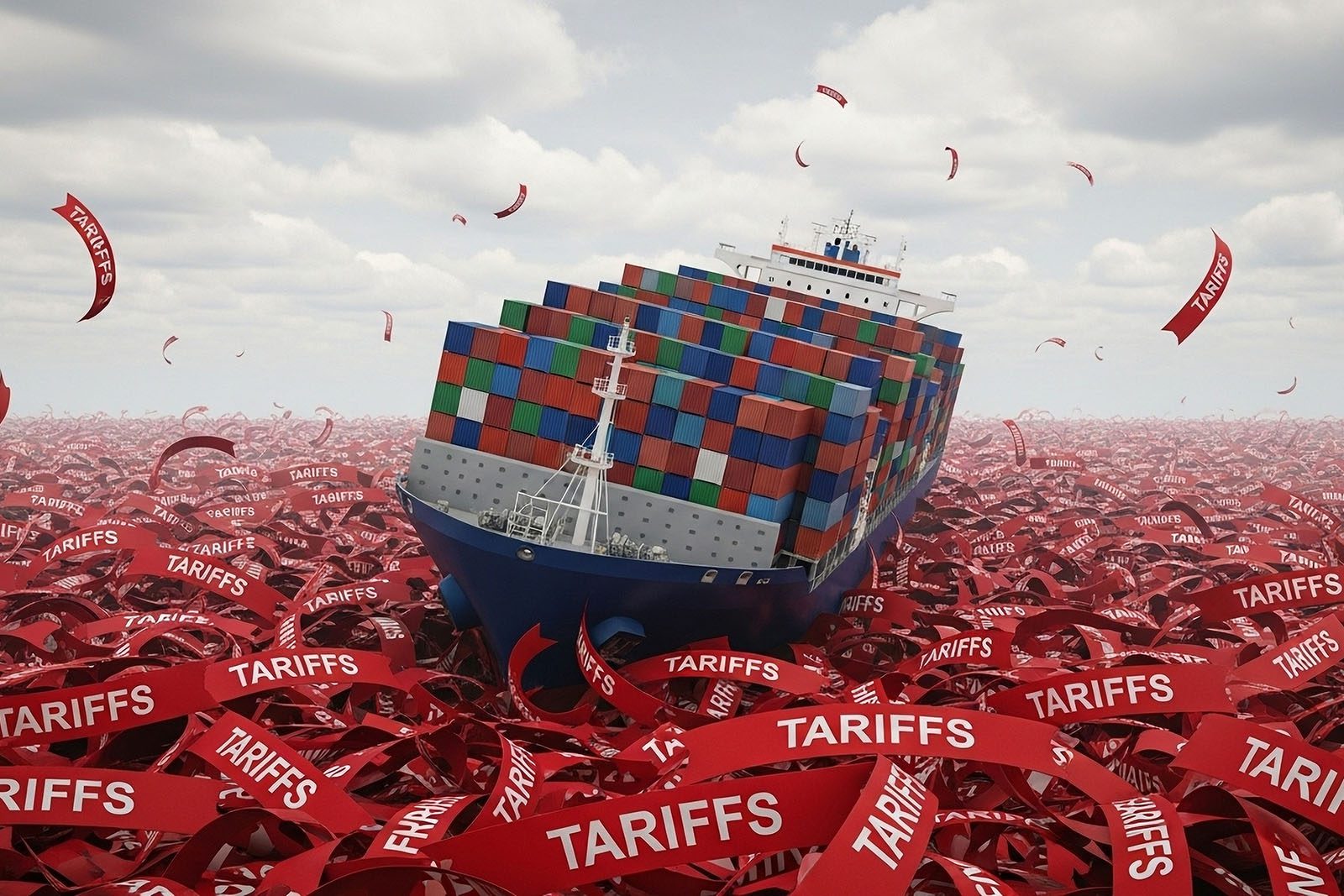


Summary: For Canadian manufacturing, changes in U.S. policy have had a notable impact. With new tariffs on steel, aluminium, and automotive products, particularly, as well as increasing import/export costs, we’re seeing a complex new environment. In this article, Aprio delves into these shifts and explores compensatory strategies that can aid manufacturers.
Shifts in the U.S. trade landscape inevitably have had a knock-on effect on Canadian manufacturers, with the U.S. still being one of Canada’s largest trade partners. These policy shifts impact production, planning, pricing, and long-term competitiveness, and it’s critical that Canadian manufacturers plan for these disruptions.
Understanding the Current U.S. Trade Policy Environment
2025 has brought the U.S. a suite of policy changes, aimed at incentivizing a return of manufacturing to U.S. shores and greater competitiveness through protectionist policies. For an increasingly globalized market, these can be a great source of uncertainty, both within and outside of the U.S.
Many of these changes are codified in the H.R.1 bill, colloquially known as the One Big Beautiful Bill Act or OBBBA. However, it is worth bearing in mind that many of these simply fortify provisions already seen in 2017’s Tax Cuts and Jobs Act. The regulations for interpreting the act are likely to be fully implemented towards the middle of 2026. These offer lower tax rates and several key incentives for U.S. manufacturers to both scale and reshore.
Of greater note for the wider manufacturing market, however, is the return of tariffs as a way to reach trade policy goals, a feature of both administrations under President Trump.
Reshoring and Nearshoring
While the U.S. focus on reshoring is particularly sharp, it reflects a global trend. Supply chain disruption during the COVID pandemic was rife, forcing many industries to look to reshaped regional dependencies and diversified supply chains. The current climate favours a move from simple cost-optimized supply chains to one where risk management is core. From cheapest to safest, as the Bank of America phrases it.
The Tariff Question
In April 2025, a universal tariff on all trade partners was announced. Furthermore, individual higher tariffs were enacted on countries with notable trade deficits with the U.S., put forth under the idea of “underlying nonreciprocal treatment.”
Canada, the U.S., and Mexico once traded under the North American Free Trade Agreement (NAFTA), but was replaced in 2020 by the United States-Mexico-Canada Agreement (USMCA), also called the Canada-United States-Mexico agreement (CUSMA). The trade deficit widened under the CUSMA to a projected US$263 billion in 2025, more than doubling from 2020’s US$125 billion.
Additionally, 2026 is also the year the CUSMA will be renegotiated, with the first revision due for presentation in July 2026.
The Current State of U.S. Tariffs on Canada
U.S. tariffs have been volatile, sometimes changing from week to week. JD Supra offers a full timeline of tariffs on Canada to date.
The latest volley in the tariff war opened with 25% tariffs on Canadian products, rising to 35% as of August 1, 2025, and with a 10% tariff on mineral and energy resources, with exemptions for CUSMA-compliant products, aside from steel and aluminium imports, later adding copper, which now stand at 50%.
Retaliatory 25% tariffs on U.S. aluminium and steel were then enacted. There has also been a volley of reciprocal tariffs in the automotive industry and, as of October 2025, 10% tariffs on Canadian softwoods and lumber, and 25% on certain wooden furniture and fittings.
To protect the steel and lumber industries, new reduced tariff rate quotas for imported steel products were introduced in December 2025 as follows:
- Up to 20% of 2024 levels for non-free trade agreement partners,
- Up to 75% of 2024 levels for non-CUSMA free trade agreement partners.
- Over-quotas will still face 50% surtaxes.
While Canada continues to honour the terms of CUSMA, a 25% tariff for steel derivatives will also apply.
Tariff remissions for U.S. steel used in Canadian manufacturing, processing, and food/beverage packaging will end on January 31, 2026, although those used for auto parts and vehicles, alongside aerospace products and aluminium will not lapse until June 30, 2026. Public health and safety goods have a similar timeline.
The Prime Minister also announced other changes to offset tariff impacts and build Canadian industries. While CUSMA ensures a swathe of Canada-U.S. commerce is still relatively unimpacted by tariffs, its renegotiation may shift that landscape further in 2026.
Trade Flows and Exports
For Canadian manufacturers who have depended on integrated supply chains with the U.S., these changes make for uncertainty and changing logistic and market strategies, with impacts such as:
- Reduced exports of manufactured goods subject to U.S. tariffs due to lower demand and competitive positioning
- Declining automotive exports with rising cost pressures
- Cyclical tariff headwinds for heavy manufacturing, although machinery/equipment have been comparatively resilient
The result is export volume contractions and cost increases for Canadian manufacturers reliant on exports to the U.S., as many seek to pivot to new markets. This, in turn, creates squeezed margins where manufacturers cannot absorb price increases or adjust supply chains quickly. This has a knock-on effect on contract negotiations and pricing decisions for those with U.S. exposure.
Workforce and Buyer Impacts
This impacts the labour market as well.
Statistics Canada tells us that in Q2 of 2025, payroll employment (i.e., formal employees, not contractors or temporary staff) in U.S.-dependent industries was down despite growth in all other industries. Lower demand for tariff-affected manufactured goods means reduced orders and investment uncertainty.
Some firms are scaling back production and staffing, or delaying capital expenditures. Such decisions have downstream effects on jobs, supplier contracts, and skills planning for manufacturing workers, and overall gross domestic product may be adversely impacted.
Strategic Responses for Manufacturing Firms
While there is still hope for improvement in the ongoing tariff volatility, manufacturers need to plan for a future where the U.S. no longer has full priority.
These impacts can be mitigated by:
- Exports Beyond the U.S.: Single trade partners are no longer viable. Alternative markets are a must.
- Changing Supply Chains and Sourcing: Examine your country-specific risk and vendor vulnerabilities. Then develop domestic or alternative suppliers to help mitigate cost increases.
- Adjust Pricing and Contract Terms: Adjusted contract terms should consider higher import costs and tariff exposures. Explore new pricing, and use cost pass-through to offset tariffs.
- Tariff Planning Strategies: These will vary by sector and goods, but could include advanced deliveries ahead of new fluctuations. Alternatively, bonded warehouses and foreign trade zones, or duty drawback programs, can be trialled.
- Optimize Operations: Look for opportunities for efficiency and cost reduction, especially regarding workforce productivity. Moreover, prioritize value-generating long-term investments and high-return capital outlays.
The Government of Canada offers a set of resources to help Canadian exporters facing U.S. tariff pressures. Additionally, support measures for the steel and lumber sectors, including loan guarantees and freight subsidies, are being enacted or explored at a governmental level.
Final Thoughts: Trade Volatility Will Be a New Norm for Canadian Manufacturers
While the shift and inherent volatility in U.S. trade policy has brought on new pressures for Canadian manufacturing, targeted and strategic responses, supported by government initiatives, will help manufacturers manage risk and sustain growth.
Aprio supports small and mid-sized Canadian manufacturers in navigating these international trade risks and developing adaptable supply chain strategies. If you’re in need of support for assessing tariff exposure and resiliency, our advisors are on hand to help. Schedule a consultation today.